

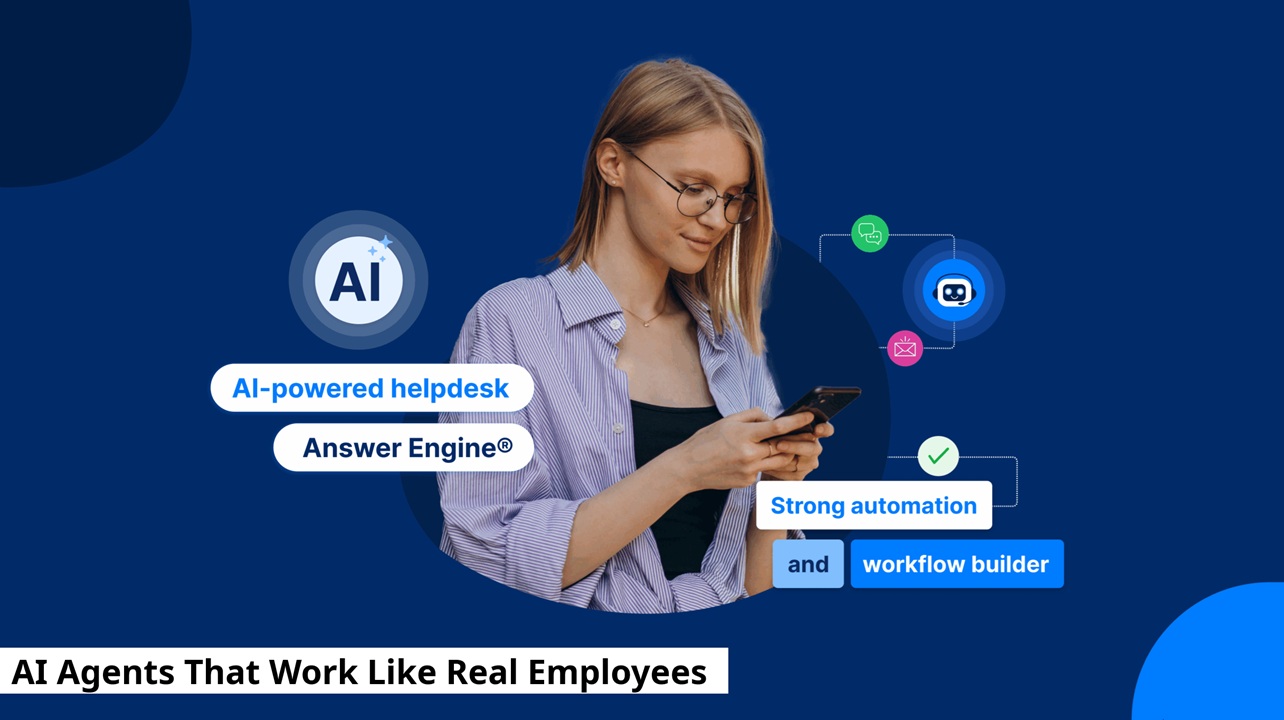
A few years ago, most companies saw AI as a helper. It could answer questions, recommend products, or automate one small task at a time. That version of AI still exists, but it no longer tells the whole story.
In 2026, many businesses are using AI agents that act more like team members than tools. They are not just waiting for instructions. They can take a goal, figure out the steps, and carry work forward with limited supervision.
Put simply, an AI agent is a digital worker that can understand objectives, make decisions within set limits, and complete tasks on its own. Companies often compare them to employees because they can plan their workload, remember past interactions, and improve when given feedback.
This shift is happening for a few clear reasons:
-
Productivity: AI agents can run continuously without fatigue.
-
Cost control: One agent can cover work that once required several repetitive roles.
-
Scalability: New agents can be deployed far faster than hiring and training staff.
This guide breaks down how these agents work, what roles they handle well, and where people still play the biggest role. It is written for business leaders and operators who want a realistic, grounded view.
What It Means for an AI Agent to “Work Like an Employee”
An AI agent that works like an employee is software built to pursue a defined goal with some independence. Instead of needing step by step commands, it can decide how to move from objective to outcome.
Traditional AI tools are reactive. You ask, they answer.
AI agents are proactive. They can:
-
Break a goal into smaller steps
-
Select tools or data sources
-
Take actions
-
Adjust when results are not ideal
For example, a basic AI tool might draft a single email. An AI agent could manage an inbox, sort messages by priority, reply to routine requests, schedule follow ups, and flag sensitive issues for a human.
Under the hood, these systems use language models, memory systems, and decision loops. They do not “think” like humans, but they can evaluate context, compare options, and choose actions that move them toward a goal.
The key difference is autonomy. They are not simple scripts or chatbots. They are designed to operate within boundaries and make choices along the way.
How AI Agents Work Behind the Scenes
Even the most impressive AI agent runs on structured processes. The magic comes from design, not mystery.
Task planning
When given a goal, the agent splits it into smaller actions. That might mean gathering data, using certain software tools, or scheduling tasks for later. Planning keeps the work organized.
Memory and context
Agents use short term and long term memory.
-
Short term memory helps with the current task.
-
Long term memory stores preferences, patterns, and past outcomes.
This is why a good agent feels consistent instead of forgetful.
Decision loops
After each action, the agent checks the result. If it worked, it continues. If not, it tries a different approach or asks for help. This cycle repeats until the task is finished or escalated.
Tool use
Modern agents can interact with real systems, such as CRMs, databases, calendars, and messaging platforms. They do not just suggest actions, they can carry them out.
This combination is what separates modern agents from simple automation.
Common Types of AI Agents in Business
1. Customer Support Agents
They handle chats, emails, and social messages. They resolve routine issues, track open cases, and pass complex situations to humans. Over time, they learn which solutions work best.
2. Sales and Lead Generation Agents
These agents qualify leads, send outreach, and follow up based on behavior. They help sales teams focus on the most promising opportunities.
3. Marketing and Content Agents
They help plan campaigns, draft content, analyze results, and suggest improvements. They reduce execution pressure so marketers can focus on strategy.
4. Operations Agents
They manage scheduling, reporting, compliance checks, and workflow coordination. They are especially useful where delays and bottlenecks are costly.
5. Data and Research Agents
They gather information, spot trends, summarize reports, and monitor markets. They turn large volumes of data into usable insights.
Real World Business Use
Many companies already rely on AI agents quietly in the background.
-
Customer service: Agents handle routine requests and pass complex cases to people. This shortens response times.
-
Ecommerce: Agents monitor inventory and trigger reorders when needed.
-
Content teams: Agents track deadlines, suggest topics, and flag outdated material.
-
Research teams: Agents scan news and regulations, then deliver summaries.
The real value is not flashiness. It is reliability and continuity.
Skills That Make AI Agents Feel “Employee Like”
Learning from feedback
When corrected, good systems adjust future behavior.
Multitasking
They can run many workflows at once without losing focus.
Context retention
They remember preferences, histories, and prior decisions.
Collaboration
They can ask for approval or escalate issues when needed.
Error correction
They can detect failures and try alternative approaches.
These qualities make them feel less like tools and more like junior team members.
AI Agents vs Human Employees
Speed
Agents act almost instantly, which suits time sensitive work.
Cost
They have predictable operating costs and no turnover.
Creativity
Humans still lead in original thinking and storytelling.
Emotional intelligence
Agents can simulate empathy but do not feel it. Human judgment matters in sensitive moments.
Judgment and ethics
People bring intuition and moral reasoning that AI cannot replicate.
The most effective model is collaboration, not replacement.
Benefits for Businesses
-
Lower operating costs
-
24/7 availability
-
Fast scalability
-
Consistent execution
-
Faster turnaround on routine work
All of this frees human teams to focus on higher value tasks.
Limitations and Risks
Hallucinations
Agents can produce wrong information if data is weak.
Data privacy
Strong controls and audits are essential.
Limited judgment
They follow logic, not ethics or real world consequences.
Overdependence
If teams rely too heavily on automation, skills can erode.
Good governance and oversight reduce these risks.
How to Implement AI Agents
-
Start with repetitive, rule based tasks.
-
Choose the right type of agent for the job.
-
Train it on quality internal data.
-
Keep humans reviewing early outputs.
-
Scale gradually after proven success.
A careful rollout prevents expensive mistakes.
The Future Workplace
The future likely involves teams of specialized agents working together. Some systems already act like “AI managers,” assigning tasks and optimizing workflows.
Human roles will shift toward creativity, leadership, and oversight. New jobs will appear in AI supervision, ethics, and system design.
Work will change, but it will not disappear.
FAQs
Are AI agents better than employees?
They are better at speed and repetition. Humans are better at creativity and judgment.
Can they replace people?
They replace tasks more than entire roles.
Are they safe for data?
Yes, with strong security and governance.
Who benefits most?
Industries with high volume processes like ecommerce, finance, and customer service.
What do they cost?
It varies, but many companies see ROI within months.
Conclusion
AI agents are no longer experiments. They are practical digital workers that can take on real responsibilities within limits. Treating them like team members helps set expectations and governance.
Still, they work best as support for people, not substitutes for human judgment. Companies that combine human strengths with instantaitools.com efficiency will be in the strongest position going forward.