

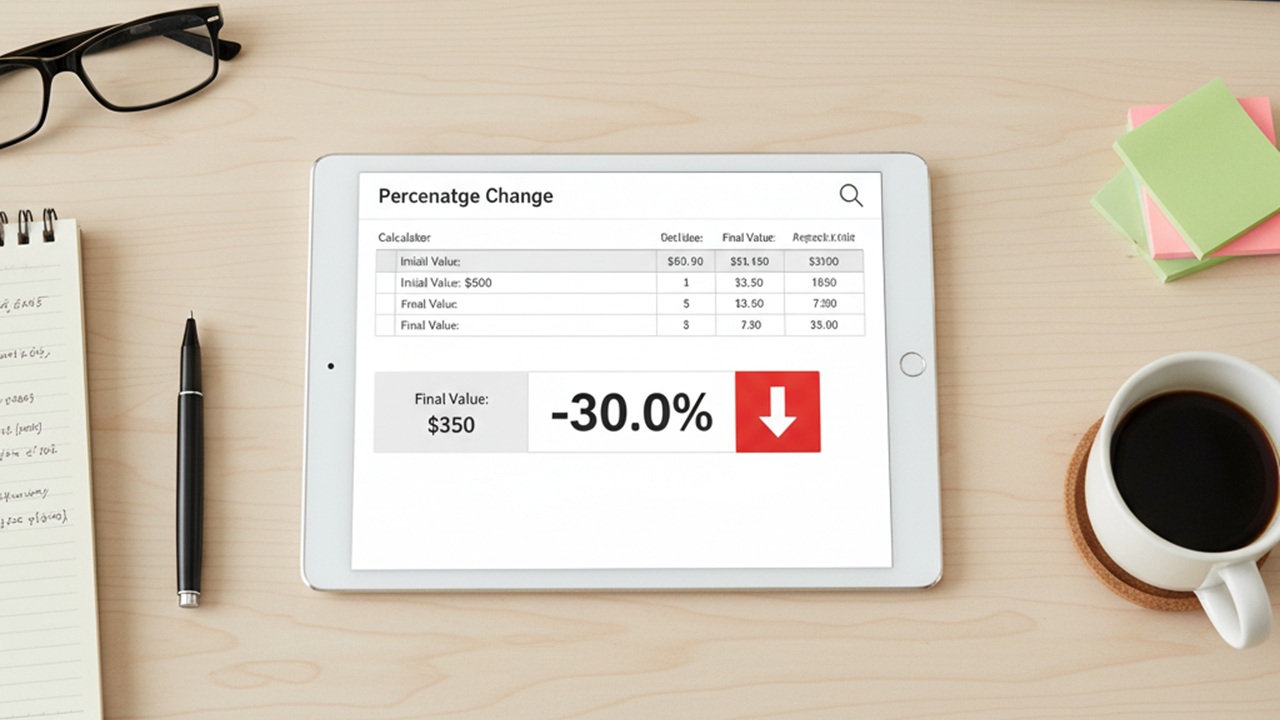
Numbers change constantly in everyday life. Prices rise, exam scores improve, businesses grow, and sometimes values drop as well. Simply looking at the difference between two numbers does not always tell the full story. This is where percentage change becomes useful.
Percentage change helps people understand how much something has increased or decreased relative to its original value. For example, if the price of a product increases from 100 to 120, knowing that the change is 20 is helpful, but understanding that it represents a 20 percent increase gives clearer context.
You will see percentage change used in many real situations such as tracking business growth, comparing yearly profits, analyzing stock market movements, or checking improvement in academic performance.
To make these calculations easier, many people use a percentage change calculator. It quickly compares two values and shows the increase or decrease in percentage form, saving time and reducing mistakes.
What Is Percentage Change?
Percentage change is a mathematical way of describing how much a value has increased or decreased compared to its original amount. Instead of just showing the difference between two numbers, it expresses the change as a percentage.
The idea is simple. You begin with an original value and then compare it with a new value. The percentage change tells you how large the difference is relative to the starting number.
If the new value is higher than the original value, the result is called a percentage increase. For example, if a company’s revenue grows from 10,000 to 12,000, the business has experienced an increase.
On the other hand, if the new value is smaller than the original value, the result is known as a percentage decrease. For instance, if the price of a product drops from 50 to 40, it represents a decrease.
Understanding this concept helps people quickly interpret trends and changes in data.
Percentage Change Formula Explained
The standard formula used to calculate percentage change is simple but very powerful:
Percentage Change = ((New Value − Original Value) ÷ Original Value) × 100
Each part of this formula plays an important role.
First, you subtract the original value from the new value. This gives you the actual difference between the two numbers.
Next, you divide that difference by the original value. This step helps measure how big the change is relative to where you started.
Finally, you multiply the result by 100 to convert the value into a percentage.
For example, imagine a student’s exam score improves from 60 to 75. The difference between the scores is 15. Dividing 15 by the original score of 60 gives 0.25. When multiplied by 100, the result is 25 percent. This means the student’s score improved by 25 percent.
This formula works for both increases and decreases.
What Is a Percentage Change Calculator?
A percentage change calculator is an online tool designed to calculate the increase or decrease between two numbers automatically. Instead of performing manual calculations, the tool does the work instantly.
To use the calculator, you simply enter the original value and the new value. Once the numbers are entered, the calculator applies the percentage change formula and shows the result within seconds.
The biggest advantage of using a calculator like this is accuracy. Manual calculations can sometimes lead to small errors, especially when dealing with large numbers or decimals. An automated tool removes that risk.
It also saves time. Students, business owners, and analysts often need to compare numbers quickly. A percentage change calculator provides instant results without requiring complex math.
Because of this convenience, many people rely on online tools when analyzing financial data, academic results, or market trends.
How to Use a Percentage Change Calculator Step by Step
Using a percentage change calculator is very simple, even if you are not comfortable with formulas.
Step one is entering the original value. This is the starting number before any change occurred. For example, it could be the original price of a product or a previous exam score.
Step two is entering the new value. This represents the updated number after the change. It might be the new price, updated revenue, or a new score.
Step three is clicking the calculate button. Once you do this, the calculator processes the numbers using the percentage change formula.
Step four is reviewing the result. The tool will show whether the change represents an increase or a decrease and display the percentage value.
The calculator automatically determines the direction of the change. If the new value is higher than the original, the result will be shown as an increase. If it is lower, the result will appear as a decrease.
This simple process makes percentage calculations quick and stress free.
Real Life Examples of Percentage Change
Percentage change is used in many everyday situations. Understanding it can help you interpret numbers more clearly.
One common example is price changes in stores. If the price of a product rises from 200 to 240, the increase can be expressed as a percentage. This helps customers understand how much the cost has changed.
Businesses often use percentage change to track revenue growth. For example, if a company’s monthly income rises from 50,000 to 65,000, the percentage change shows how quickly the business is growing.
Students can also benefit from this concept. Imagine a student improving their exam score from 70 to 85. Calculating the percentage increase helps show the improvement more clearly than just looking at the raw numbers.
Investors frequently analyze stock market changes using percentage change. When stock prices move up or down, percentages provide a clear way to measure gains or losses.
Population growth statistics, economic reports, and marketing performance data also rely heavily on percentage change calculations.
Percentage Increase vs Percentage Decrease
Percentage increase and percentage decrease both measure change, but they represent opposite directions.
A percentage increase occurs when the new value is higher than the original value. For example, if a product price rises from 100 to 120, the change represents a 20 percent increase.
A percentage decrease happens when the new value becomes smaller than the original value. For instance, if a store reduces the price of an item from 80 to 60, the result shows a decrease.
Understanding this difference helps people interpret data more accurately.
When using a calculator, the result usually appears with a positive value for increases and a negative value for decreases. This makes it easy to quickly see whether the number has grown or declined.
Many people also compare changes using a percentage difference calculator when they want to measure how far apart two values are without focusing on which one came first.
Common Mistakes When Calculating Percentage Change
Although the formula is simple, people often make mistakes when calculating percentage change manually.
One common mistake is using the wrong original value. The original value must always be the starting point in the calculation. If the numbers are reversed, the result will be incorrect.
Another frequent error is confusing percentage change with percentage difference. These two concepts are related but used in different situations.
Manual calculation errors can also occur when working with decimals or larger numbers. Even a small mistake in subtraction or division can change the final result.
Using an online tool reduces these risks. For example, a percentage decrease calculator can instantly calculate reductions and eliminate calculation errors when values drop.
Automated tools ensure the formula is applied correctly every time.
Benefits of Using a Percentage Change Calculator
A percentage change calculator offers several practical advantages.
One of the biggest benefits is saving time. Instead of writing out formulas and performing multiple steps, the tool delivers results instantly.
Another important advantage is accuracy. Manual calculations can sometimes lead to mistakes, especially when dealing with multiple values or decimal numbers. A calculator reduces this risk.
Students often use these tools while studying mathematics or analyzing data in school assignments. Professionals also rely on them for financial reports, market research, and performance tracking.
Online calculators make data analysis easier for everyone, whether you are comparing business results, reviewing sales performance, or simply checking price changes while shopping.
Because of their simplicity and reliability, these tools have become widely used across education, finance, and everyday decision making.
Percentage Change in Business, Finance, and Daily Life
Percentage change plays an important role in many industries and everyday decisions.
Businesses use it to track performance over time. For example, companies compare monthly sales, annual revenue, and customer growth to evaluate progress.
In finance, investors analyze percentage changes in stock prices, interest rates, and market indexes. These calculations help them understand gains, losses, and investment trends.
Retailers also rely on percentage change when adjusting product prices or offering discounts. Understanding how prices shift helps businesses stay competitive.
Individuals often use percentage calculations for budgeting and personal finance. For instance, people compare changes in expenses, savings growth, or salary increases.
Economic reports also depend heavily on percentage change. Governments and analysts track inflation, unemployment rates, and population growth using percentage based comparisons.
Because of its wide use, percentage change has become one of the most important tools for understanding numerical trends.
Percentage Change vs Percentage Difference
Although they sound similar, percentage change and percentage difference are not exactly the same.
Percentage change compares a new value with an original value and shows how much it has increased or decreased.
Percentage difference, on the other hand, measures how far two numbers are apart without focusing on which value came first.
For example, if two products cost 100 and 120, percentage change would measure the increase from 100 to 120. Percentage difference would simply compare how different the two prices are.
Both calculations are useful depending on the situation. Percentage change is commonly used for time based comparisons, while percentage difference is often used when comparing two separate values.
Understanding this distinction helps ensure the correct calculation is used for each scenario.
Conclusion: Make Data Easier to Understand with a Percentage Change Calculator
Understanding percentage change makes it much easier to interpret numbers and trends. Whether you are analyzing business growth, tracking exam scores, or comparing prices, percentages provide a clear picture of how values move over time.
While the formula itself is straightforward, manual calculations can sometimes take time and lead to small mistakes. That is why many people rely on online tools to simplify the process.
A percentage change calculator quickly compares two numbers and shows whether the result represents an increase or a decrease. With just a few inputs, you can understand changes in data more clearly.
Whenever you need to measure growth, decline, or progress, using a percentage change calculator can save time and make your analysis far more accurate.